Frequently Asked Questions: Conscientious Objectors & Risk of Draft
Why are you posting about the draft in 2026 when there’s no draft?
I have a fair number of friends and family members who have adult children who might be theoretically eligible if a draft was activated in the United States. Because my law practice focuses on federal matters, I’ve been getting questions. Specifically, if there’s a modern draft, will their kids be at risk of involuntary conscription? What are the rules on getting out of it?
These inquiries are coming up as the United States enters into an elective armed conflict in Iran. At this point it seems to me that a draft is unlikely. One barrier to a activating the draft is that it would require an act of Congress. Another barrier is that it would be extraordinarily politically unpopular. This FAQ about the draft and conscientious objectors is offered with that base line of skepticism about where we are headed.
That said, April 2026 news headlines say that selective service registration will soon be automated. Instead of registering at the post office at 18 years old, automatic draft registration will be entered for U.S. Citizen and immigrant men based on social security and other government based identifiers. That is rattling people.
I’m no expert on the draft. It hasn’t happened in so long that there really aren’t that many expert civilian attorneys on the draft these days. So I’ve been looking into it, God forbid.
What the Law Says about the Draft in 2026:
The system is governed primarily by the Military Selective Service Act (MSSA), 50 U.S.C. § 3801 et seq.The United States hasn't conducted an active draft since 1973, when the Vietnam-era induction authority expired. What remains is the Selective Service System (SSS). It’s a registration framework that keeps a pool of draft-eligible men on record so that the government can activate a draft quickly if necessary.
In December 2025 a provision of the NDAA was passed requiring automatic Selective Service registration for eligible men beginning December 18, 2026. Starting on that date, the SSS will pull data from existing federal databases (Social Security, USCIS, etc.) to register men ages 18–26, eliminating the requirement that men self-register. Until that date, the existing system and its penalties remain in effect.
Who is Currently Exempt from Draft Registration?
The SSS carves out a narrow set of people who don't have to register at all:
Active duty service members (and Officer Procurement candidates, cadets, and midshipmen at service academies)
Non-immigrant visa holders — men in the U.S. on student (F-1), tourist (B-2), diplomatic, or similar temporary visas are exempt as long as their visa remains valid. If the visa lapses while they're under 26, they become required to register.
Men who are incarcerated, hospitalized, or institutionalized during the registration window
Men who turn 26 without having registered — they are no longer subject to the registration requirement, but they permanently forfeit the federal benefits tied to registration.
Who must register right now?
According to the SSS, Any male U.S. citizen or male immigrant living in the U.S. must register within 30 days of their 18th birthday, up to age 26. This includes undocumented immigrants and lawful permanent residents. Cisgender women are still not required to register. That’s a gender barrier that the government has left alone.
Can a student studying abroad or living outside of the U.S. still be drafted?
Yes. U.S. citizenship is the operative factor. Physical location has not been a barrier to being drafted in the past or under current rules. Male U.S. citizens living or studying abroad between ages 18–25 are required to register, and can do so online, via U.S. embassy/consulate, or by mailing a form from overseas using a foreign address. Being in another country does not provide an exemption from registration or an exclusion from draft eligibility. The only carve-out relevant to students is for foreign nationals studying in the U.S. on valid student visas (F-1) — they are exempt from registration as non-immigrants
Who would be exempt if a draft were called?
If Congress authorized inductions, the following categories would likely be eligible to claim exemption or deferment (subject to a local draft board's determination):
Sole surviving sons of a family (to prevent wiping out an entire family line in combat)
Certain elected and appointed officials
Veterans who have already served (generally exempt from a peacetime draft)
Hardship cases (men whose induction would cause extreme hardship to dependents)
Ministers and ministerial students in accredited religious programs
Those physically or mentally unfit for service and classified as such after a military entrance medical exam
Conscientious objectors (see below)
Dual nationals and certain immigrants, depending on residency and bilateral treaties
Conscientious Objectors: How does that work before a draft?
Within the SSS, you can’t pre-classify yourself as a conscientious objector (CO). There is no box to check when you register. CO status is a claim made to a local draft board after induction has been ordered.
A Class 1-O CO opposes all military service on grounds of religious training or sincere moral belief. Those draftees could be assigned to alternative civilian service. A Class 1-A-O CO objects only to combatant service but is willing to serve in a non-combat military role (as a medic, for example).
Once a draft is activated, the SSS estimates the first inductees could have as few as 7–10 days between receiving their induction notice and having to report. Registrants file a CO claim after being found physically qualified for service.
How does a person demonstrate a high enough level of conscientious objection to be exempt?
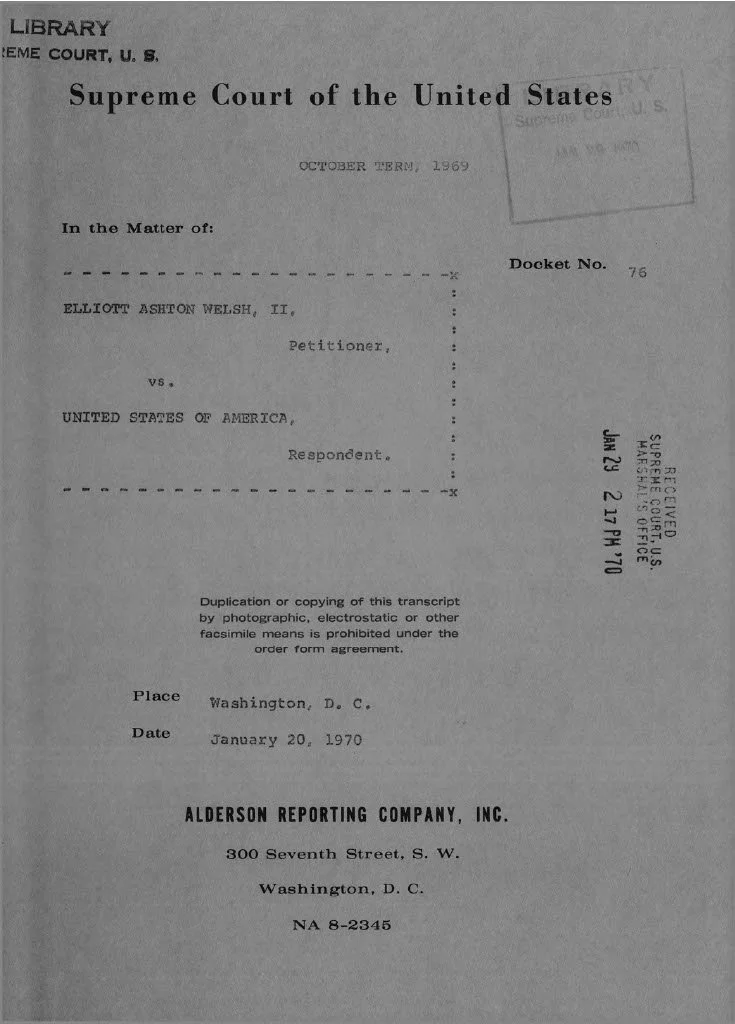
The standard bearing case is Welsh v. United States, 398 U.S. 333 (1970). In Welsh, the Supreme Court defined qualifying creed as religious belief or beliefs “that are purely ethical or moral in source and content but that nevertheless impose upon [the registrant] a duty of conscience to refrain from participating in any war at any time.” The belief should be “held with the strength of more traditional religious convictions.”
What the claim requires: the burden is on the registrant to demonstrate sincerity. Decision makers may look for:
A written personal statement explaining the nature and origin of your beliefs
Whether the beliefs are religious or "a deeply held moral or ethical belief that functions like a religion."
Statements from character witnesses who can speak to the sincerity and consistency of your beliefs
Evidence that you’ve been living in a manner consistent with pacifist values.
Is there anything draft-aged young people can do now if they believe they may qualify as conscientious objectors?
The smart move for anyone who holds these beliefs is to begin documenting them now. Especially if the objection isn’t something covered by religious commitments, creating a record of belief through journaling, letters to religious/ethical advisors, and participation in peace organizations could be helpful. If there's a paper trail that predates any draft notice, it could help to show that resistance to induction isn’t a sudden (convenient) ethical epiphany.
When Welsh was drafted and filled out his conscientious objector form, he crossed out the words “religious training” stating that his opposition to war rested on his beliefs and conscience rather than a traditional religion. He elaborated that he had “deep conscientious scruples” against participating in wars where people were killed. He described his beliefs as a sense that taking life is morally wrong.
Ideas for establishing deeply held opposition to military service:
Blogging, writing and journaling about deeply held pacifist beliefs.
Corroboration in life choices such as avoiding violent professions, refusal to bear arms and community or volunteer work that reflects the same ethic. of respect for life.
Developing relationships with community contacts who could later provide affidavits attesting to the longstanding, deeply held pacifist commitments.
Courts and draft boards may be more likely to accept a conscientious objection to military service if the applicant can document and support the history, sincerity and depth of their convictions.