Federal Target Letters
A letter from the U.S. Department of Justice could be a target letter and is a serious escalation of a federal criminal investigation. If you’ve received a letter from the United States Attorney’s Office, prompt assistance of an experienced federal criminal defense lawyer is crucial.
What is a target letter?
A federal target letter is a formal notice from a U.S. Attorney’s Office (USAO) or other federal prosecutor that the government considers you a “target” of a federal criminal investigation. It usually notifies the target of a coming grand jury investigation. Target letters come from USAO policy and are not required by law. In the letter, the assigned federal prosecutor explains he or she has substantial evidence linking you to a crime. It is a preliminary document sometimes used in prosecuting non-violent allegations against a person with a low risk of fleeing from prosecution. In these cases, the government has decided to communicate with you up front instead of making an urgent arrest. A target letter is a strong signal that the federal prosecutor is preparing formal federal criminal charges.
What do target letters look like?
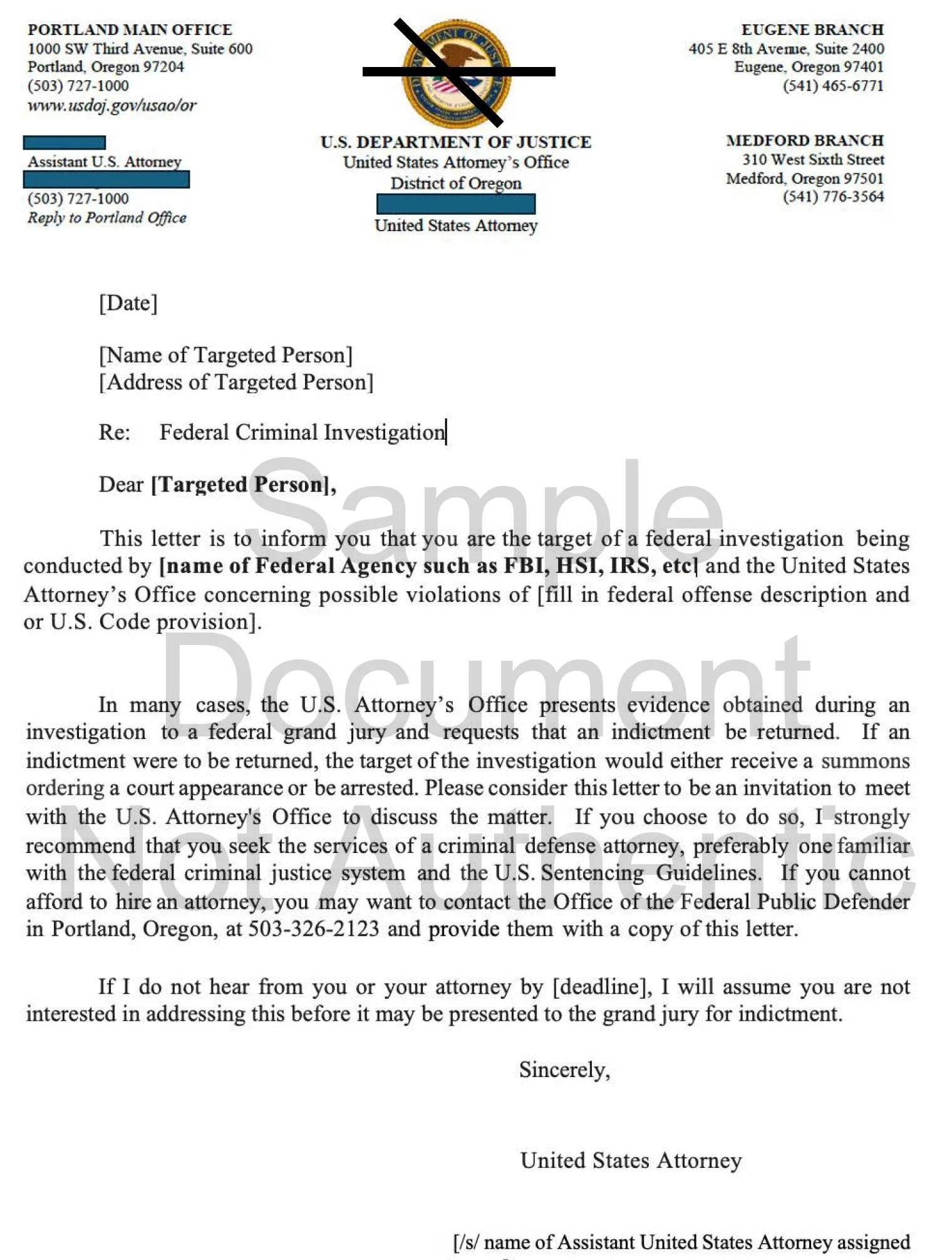
Here is an exampleof a Federal Target Letter in the District of Oregon. A federal target letter is usually a formal business letter printed on official U.S. Department of Justice or United States Attorney's Office letterhead. It typically includes your name and address, the name of the assigned Assistant United States Attorney, a subject line identifying the federal investigation, and an explanation that you are considered the target of a criminal investigation. While the format and wording may vary between districts, most target letters have a similar professional appearance and are delivered as official government correspondence.
The image shown is a sample for illustration purposes only. Actual target letters vary by U.S. Attorney's Office and the circumstances of the investigation.
What does it mean to be a target?
In DOJ practice, a “target” is a prospective defendant facing “substantial evidence” of having committed a federal offense. In the prosecutor’s judgment, the target is a likely defendant in a criminal case. This is distinguished from a “subject” (whose conduct is within the scope of the investigation but as to whom the government has not yet formed that level of belief) or a mere “witness.” Sometimes the USAO sends similar looking letters to subjects and witnesses also recommending that they get a lawyer.
The most authoritative USAO source on target letters is the Criminal Resource Manual entry “160. Sample Target Letter” on the Justice Department website. It provides the official model language DOJ expects AUSAs to use when notifying someone that they are a grand jury target.
How do people receive target letters?
Sometimes a person will get their target letter in the mail. It is very common, however, for it to be hand delivered by one or two federal investigators. When face to face with federal investigators, it is critical that a targeted person not make statements about the matter and contact counsel immediately.
Which federal agents have delivered the letter or otherwise made contact is a big clue as to what the investigation is about. Target letters can come from investigations involving the FBI, HSI, IRS, or many another federal agencies working with the U.S. Attorney's Office on a federal prosecution.
When a target letter is delivered, it means that almost all of the investigation for the grand jury is complete. It is not a good time to talk with the investigators without an attorney. You should assume you are being federally prosecuted and the pre-charge investigation is nearing completion. Contacting knowledgeable federal counsel at this point is an urgent priority.
Typical contents of a target letter:
While formats vary by district, a standard federal target letter usually does the following:
States that you are a target of a federal grand jury investigation and may reference specific statutes under investigation.
Summarizes the general nature or subject matter of the suspected offenses (e.g., fraud, conspiracy, obstruction).
Advises you of your Fifth Amendment right against self‑incrimination and your right to counsel, often including information about appointed counsel and how to contact the Federal Public Defender.
Often invites you to contact the AUSA to discuss the case, sometimes in lieu of or in connection with a grand jury subpoena.
Sometimes warns you not to destroy documents or tamper with witnesses.
Three things a person who has received a target letter should do:
A federal target letter is something that you need to take seriously. It is not merely a threat or an intimidation tactic. The U.S. Department of Justice has been using target letter procedures for decades. It is one of the last formal steps the government takes when it is ready to charge a person with a crime.
Because target letters appear at the end of a federal agency investigation after the case has been referred for federal prosecution, it is important to do the following:
Call a qualified and experienced federal defense lawyer immediately
Your first move should be to retain (or seek appointment of) an attorney with federal criminal experience. It is not recommended for you to respond personally to the letter. With knowledgeable counsel, you can assess your exposure, open communications with the AUSA or federal agents, and evaluate your options.
If you don’t have the resources to hire an attorney, call the Federal Public Defender in your area and ask for the duty attorney. Tell them you have received a target letter.
2. Do not talk and do not “explain.”
You should not call the prosecutor, FBI, or other agents by yourself. They want you to have a lawyer and explicitly recommended it. You should not discuss the facts of the investigation or the letter with friends, family, coworkers, or potential witnesses. Be thoughtful that the statements you make to anyone other than your attorney are not privileged. Ask your lawyer what kind of surveillance environment you may be in and about reasonable precautions to maintain privacy.
3. Preserve records and do not put information about the investigation on the internet or into AI tools.
Keep the letter and also preserve all potentially relevant documents, emails, messages, and devices that may relate to the investigation. Avoid deleting or altering anything that might be evidence, because that could be interpreted as obstruction or evidence‑tampering.
Do not post about your legal problems on social media, in group chats, or on public forums. Once something is online, prosecutors and agents can often find it and use it against you. Tell your lawyer about your social media accounts and anything that could relate to the matter or even your lifestyle.
Do not crowdfund your legal expenses before speaking with a lawyer about it first. Public fundraising pages usually require you to describe what happened, and those statements can be treated as admissions and turned into exhibits.
Do not put details about your case or strategy questions into an AI tool. It is not safe to use a consumer-grade AI chatbot for legal advice before you talk to your counsel. A recent federal decision from Judge Jed Rakoff in the Southern District of New York held that a defendant’s AI prompts and outputs were not protected by attorney‑client privilege or work‑product, and the government was allowed to use them. What you type into AI tools may be discoverable just like any other non‑privileged document.
This is not legal advice. Nothing on this page should be construed as legal advice for your particular situation. If you have received a target letter you need to arrange for counsel to immediately review the letter and give you legal advice for your individual situation.